How To Set Goals and Achieve Them
Most of the time we start with the best of intentions to change and to build our dream life, but somehow, along the way we lose that motivation and direction and fall back into bad habits.
That’s when the old habits that feel comfortable and familiar creep back in and before you know it, you’re back to your old ways.
This is where you need the direction of goals!
Learning how to set goals can be the difference of living your dream or just simply wishing for it.
In this blog post I’m going to take you through the key steps on how to set goals and achieve them.
This blog will show you how to set goals
Why Setting Goals Matters
Motivation can play a great role in achieving your dreams, but let’s be honest, motivation doesn’t always show up when you need it. This is why you need goals.
Did you know that you are 42% more likely to achieve a goal when it’s written down? Yep, that’s right!
Setting goals gives you the direction and clarity motivation can’t offer.
Start With your Why
You are more likely to stick to a goal when you are clear on why you want to set that goal.
Do you want to set a goal to lose weight, so you feel better about yourself, so you’re healthier? Are you doing it because you have children and you want to be fit and health for them?
Do you want to earn more money to be financially free? To support your family so you have more free time to spend with them?
Whatever your deeper meaning is behind the change you want to see, connecting this to your goal will give you a greater purpose.
Choose the Right Type of Goal
When you’re learning how to set goals, there are 4 main types you need to consider, these are:
Long -term goals: where you can look 3 or 5 years in the future and think about where you want to be.
Short term goals: this is looking at what you want to achieve in the next 6-12 months, which will help you get closer to the 5 year plan you might have.
Habit based goals: this looks at creating a consistent behaviour, such as walking for 20 minutes everyday.
Outcome based goals: do you want to run a marathon, or lose a certain mount of weight? Or change career?
Each of these types of goals serves a purpose when considering what you want to achieve. All I would recommend is, don’t try to set too many goals. Be realistic with what you can achieve with the time you have.
Use the SMART Framework
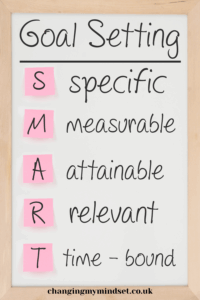
A key component on how to set goals and achieve them is using the SMART framework, here’s how it works:
Specific: Be clear on what it is you want to achieve and who it is you want to be.
Measurable: If you want to earn more money, how much? If you want to lose weight, how much?
Achievable: Don’t set yourself up for fail or set too many goals.
Relevant: Set your goals to fit who you are. If you’re not into running, then don’t set a goal for running a marathon.
Time – Bound: When do you want to achieve your goal? 6 week’s? 6 months?
Using the SMART framework is key on how to set goals as it provides clear and concise steps that can be used for all goal setting.
Break Goals into Small Actions
One of the main reasons people fail at their goals is because they feel too big. Learning how to set goals for yourself, is understanding how to break those big goals into smaller ones.
For example, you have a long- term goal to work for yourself one day. That can feel daunting when you work full time in a job that you don’t like and you’ve never worked for yourself.
What you need to do is break those goals down into small, achievable steps. If your goal is to work for yourself, you can start with naming your business, researching your competitors, setting up your social media, taking courses, learn how you might market your business, picking your niche.
There are many small, less daunting steps that you can take before you reach your overall goal.
Create a Visual Plan
A key on how you set goals and achieve them is having a visual that you can refer to everyday.
Goal Planners: You are 42% more likely to achieve a goal if you write it down! With a goal planner you can get clear on your goals, set deadlines and plan out the steps you need to take each week.
Vision Board: Having a visual on either your wall in your bedroom, or a screen saver on your phone is a great daily reminder of your goals.
Habit Trackers: This is a great way of tracking your progress and celebrating your wins.

Build Routines that Support Your Goals
Goals succeed through habits and routines. The best thing you can do is add on to a habit or routine you already do – it makes it much easier!
For instance, I wanted to start taking supplements, but I would keep these in the cupboard and guess what – I didn’t take them! So, I keep them right by the kettle now and when I’m making my morning tea, that’s when I take them.
Or, if I want to go for a run in the morning, I set my clothes out in the morning, so I’m not searching for them.
This is the key on how to set goals in life, set up your environment to support your habits.
Track Your Progress
Tracking your progress can give you such a positive dopamine rush! Having a record of your small wins, seeing where you started and where you are now is amazing.
It also allows you to see what is working, what isn’t working and what changes you might need to make to your habits or routines.
Adjust when you need to
A key element on knowing how to set goals, is knowing when you need to change those goals. It’s not about failing, it’s about being flexible to changes, understanding that situations can evolve and your goals need to.
It could be that when you initially started setting your goals you had a clear idea of what you wanted. However, over time this can change, and that’s OK. Take the time to review your goals and make sure they still align with what you want.
Remove Barriers
You need to think ahead at what might prevent you from getting where you are to where you want to be. For instance, if you want to have a better morning routine, but you’re not a morning person, then don’t say to yourself that you’ll be up at 5am every morning.
Start with getting up at 6am and ease into a morning routine by trying a different alarm to wake you up or have your favourite breakfast in so you’re more inclined to get up.
Think about what has got in your way before and try to eliminate or reduce those strains before starting.
Add motivation tools
Understanding how to set goals is also learning how to add motivation tools.
Affirmations: These are positive statements you say on a daily basis to remind yourself of what it is you’re aiming for.
Gratitude Practices: It’s important to remind yourself of the positive things you already have you in life. These don’t have to be big things, being thankful for the perfect cup of tea, a catch up with a friend or keeping to your habits can be things your grateful for.

We have gone through the main steps on how to set goals and achieve them. This provides you with the best foundation to set you up for success.
Just remember, be kind to yourself, change takes time
Share this post: on Twitter on Facebook